Do flashcards work for toddlers? What the research says
Flashcards can help little ones learn words when you use them as a game together, not a drill. What the research says, and how to play.
Flashcards Arabia · 4 min read ·
It’s one of the first questions parents ask about flashcards, and it deserves an honest answer: it depends on how you use them.
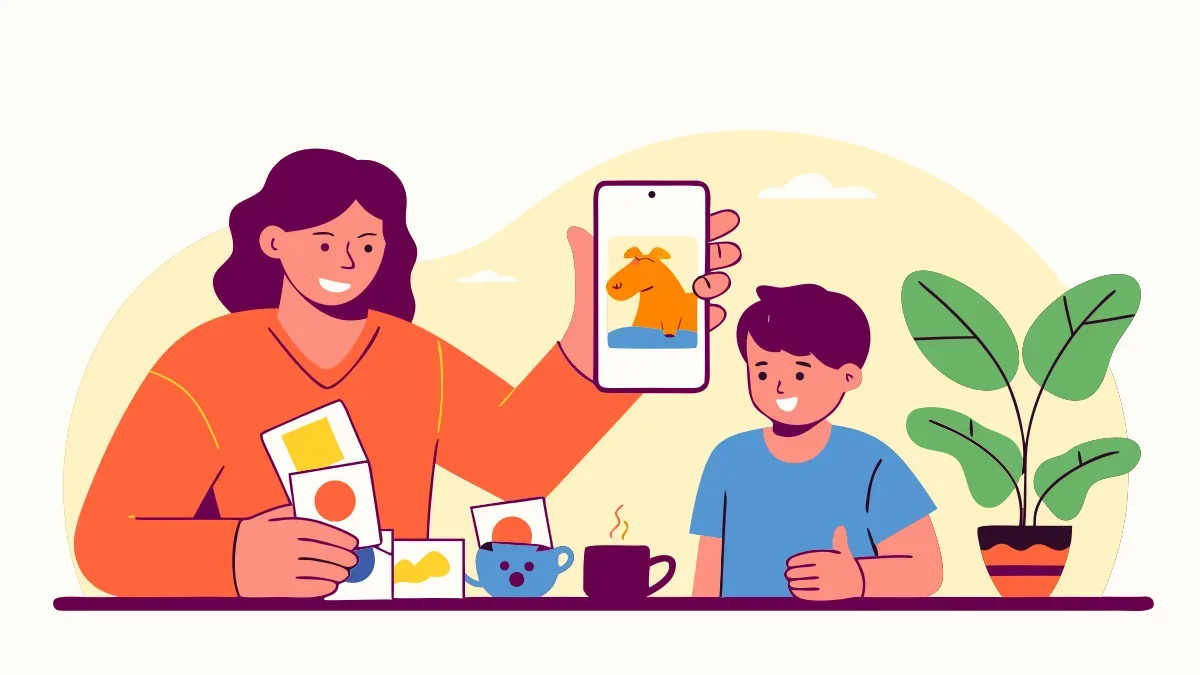
Flashcards won’t teach a baby to read, and drilling a toddler with them isn’t how young children learn. But looking at pictures together, naming them, laughing at them and finding the real thing afterwards is exactly the kind of moment where little ones pick up words. Here’s what the research says, and how to use cards in a way that fits it.
What doesn’t work: drills and “baby reading”
In a 2014 study, researchers followed 117 babies aged 9 to 18 months. Half of them used a “baby reading” programme every day for seven months: videos, word and picture flashcards, and books. At the end, the babies who used it had learned no more than the others. The only difference was that their parents believed they were learning.
The child development researchers Kathy Hirsh-Pasek and Roberta Golinkoff made a similar point in their book “Einstein Never Used Flash Cards”: rushing toddlers through academic drills doesn’t pay off, and play and everyday conversation do far more.
So if a product promises your baby will read, or get ahead, from flashcards alone, be sceptical. That includes ours: our cards are a way to play with words together, not a shortcut.
What does help: words in shared, playful moments
Following their attention. In a classic study, 17-month-olds learned new words better when an adult named the toy they were already looking at, rather than pulling their attention somewhere else, and toddlers whose mothers did this more had bigger vocabularies. With cards, that means naming the one your child is staring at, not the next one in the pile.
Hearing the same words again and again. Three-year-olds who heard the same stories several times learned and remembered more new words than children who heard a different story each time. A few cards repeated all week beat a big pile seen once.
Talking about the pictures. When parents were coached to ask questions about picture books (“What’s that? What does it do?”) instead of just reading, their children’s spoken language grew faster than other children’s. The same works with a card: ask, wait, then answer together.
Connecting the picture to the real thing. Very young toddlers find it easier to carry a word from a photo or a realistic drawing over to the real object; by about 18 months they manage it from cartoons too. Whatever cards you use, show the real thing as well: the real cup, the real banana, the neighbour’s cat.
People, not screens, do the teaching. In a well-known study, babies aged 12 to 18 months learned no more words from a popular baby video than babies who never saw it. The most learning happened when parents simply taught the words during daily life. A card, on paper or on a screen, is a prop for you; you’re the one who makes it work.
For older children: a little remembering helps
From about three, it helps to let children try to remember a word before they hear it. In studies with preschoolers, trying to recall a word led to better memory of it later than simply hearing it again, even a week on. One recent storybook study found no difference, though, so keep it light: a guessing game, never a test.
It also helps to spread things out. Two-year-olds said new words more readily when they’d heard them on several different days rather than all on one day, and three-year-olds learned new names better when the examples were spaced out rather than shown back to back. Adults learning with flashcards find the same: spacing practice out works better than cramming.
And for a second language?
The same rules apply. For toddlers, cards add to hearing a language from real people; they don’t replace it. For older children and adults, learning words deliberately with cards is a well-studied way to build vocabulary in a new language.
How to play: games, not drills
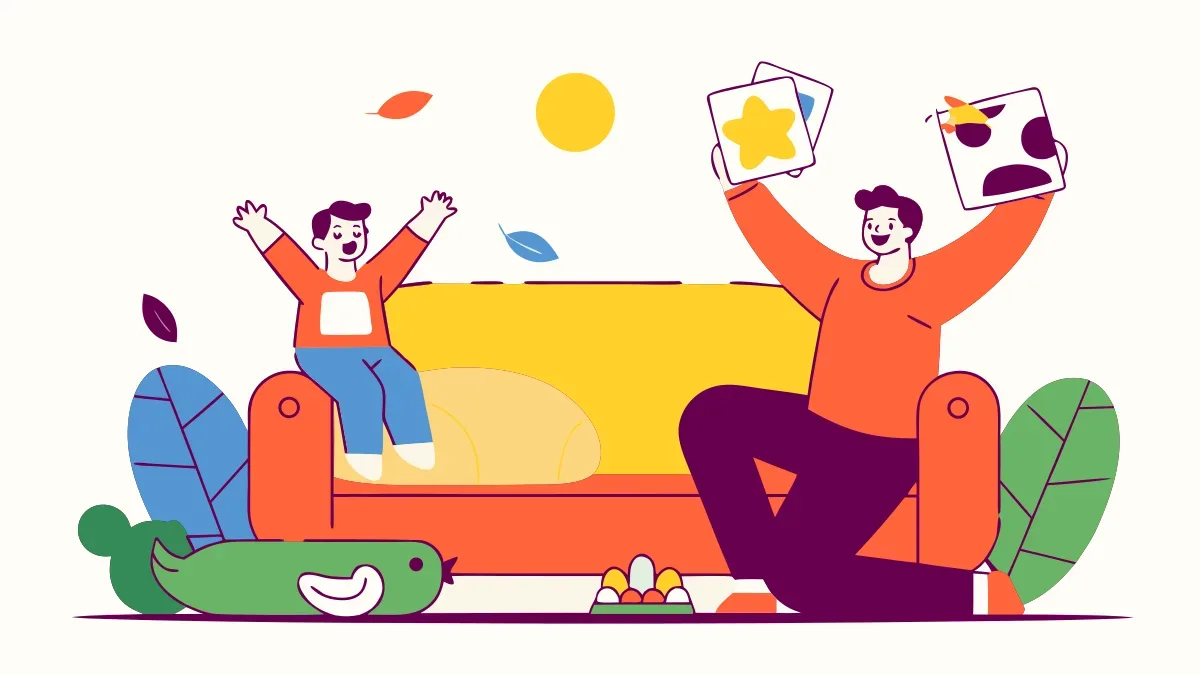
- Peekaboo: hide a card behind your back and reveal it slowly. Name it with a big smile.
- Treasure hunt: hide three cards around the room and go looking together.
- Find the real one: look at a card, then find that thing in your home.
- Sounds and actions: roar like the lion, stomp like the elephant, drive the bus.
- Silly mistakes: call the cow a cat and wait to be corrected.
- Echo in two languages: say the word in one language, then the other, and let your child echo you.
- Swap roles (age 3 and up): your child shows a card and you say the word.
Signs it’s going well, and when to stop
Your child brings you a card, points, giggles, or uses a word somewhere else entirely. That’s the goal. Stop while it’s still fun: a couple of minutes is plenty, and no child needs to be tested.
Try it tonight
Farm Animals is free in full, with no account needed: pick three animals and play peekaboo with them. For a simple daily habit, try our five-minute bilingual routine.
Sources
- Neuman, Kaefer, Pinkham and Strouse, Can babies learn to read? A randomized trial of baby media, Journal of Educational Psychology, 2014
- New York University, Education DVDs, flashcards don’t teach babies to read, The Conversation, 2014
- Hirsh-Pasek, Golinkoff and Eyer, Einstein Never Used Flash Cards, Rodale, 2003 (revised edition 2026)
- Tomasello and Farrar, Joint attention and early language, Child Development, 1986
- Horst, Parsons and Bryan, Get the story straight: contextual repetition promotes word learning from storybooks, Frontiers in Psychology, 2011
- Whitehurst and others, Accelerating language development through picture book reading, Developmental Psychology, 1988
- Strouse, Nyhout and Ganea, The role of book features in young children’s transfer of information from picture books to real-world contexts, Frontiers in Psychology, 2018
- DeLoache and others, Do babies learn from baby media?, Psychological Science, 2010
- Fritz, Morris, Nolan and Singleton, Expanding retrieval practice: an effective aid to preschool children’s learning, Quarterly Journal of Experimental Psychology, 2007
- Leonard and others, Retrieval-based word learning in young typically developing children and children with developmental language disorder I: the benefits of repeated retrieval, Journal of Speech, Language, and Hearing Research, 2019
- Knabe, Bredemann and Vlach, A lack of retrieval practice effects in children’s recognition and recall memory of novel words during storybook reading, Frontiers in Developmental Psychology, 2023
- Vlach, Sandhofer and Kornell, The spacing effect in children’s memory and category induction, Cognition, 2008
- Childers and Tomasello, Two-year-olds learn novel nouns, verbs, and conventional actions from massed or distributed exposures, Developmental Psychology, 2002
- Kornell, Optimising learning using flashcards: spacing is more effective than cramming, Applied Cognitive Psychology, 2009
- Nation, Deliberate vocabulary learning from word cards, in Learning Vocabulary in Another Language, Cambridge University Press, 3rd edition, 2022